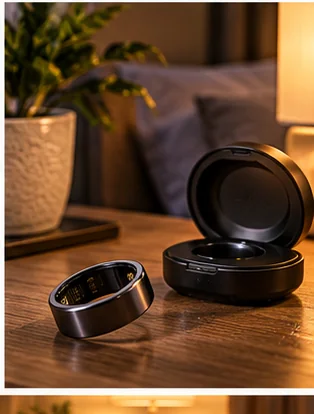
Products and configurations to compare
Oura Ring 5
The hardware is materially smaller and lighter than Ring 4 while extending rated battery life. For sleep-focused wearers who dislike a wrist device at night, the form factor is still Oura's strongest argument.
Best when: you want a low-profile sleep/recovery wearable and are comfortable with Oura membership
Watch for: sizing differs from prior Oura generations and the ongoing membership is part of ownership cost
Oura Ring 4
Ring 4 remains capable and Oura still documents 5–8 day battery life, but it is now the outgoing generation.
Best when: you find a substantial verified discount and understand the older battery/size tradeoff
Watch for: do not pay near-Ring-5 pricing for old hardware
Smart ring sizing kit
Oura recommends wearing a sizing ring at least 24 hours before finalizing Ring 5 size. Fit quality matters to comfort and signal.
Best when: you are between sizes or new to wearing a sensor ring overnight
Watch for: official Oura sizing differs by generation, so generic kits are only a rough reference
The biggest Ring 5 upgrade is physical
Oura describes Ring 5 as 40% smaller than Ring 4, with 6.09mm width, 2.28mm thickness and weight starting around 2g. Those numbers matter because a sleep wearable succeeds only if you tolerate it every night.
Battery moves from 5–8 to 6–9 days
That sounds incremental, but one extra day can move charging from 'twice in a busy week' toward a more predictable weekly routine. Actual battery still varies by size, features and age.
Membership is still part of the price
Oura's hardware page states that membership unlocks personalized insights and new features. Compare the first-year and three-year cost, not only the ring purchase.
Sleep data is useful as trend data
Bedtime consistency, overnight heart-rate trends, temperature trends and recovery patterns can be useful. Do not treat a stage graph as a clinical sleep study.
Ring 4 owners should upgrade only for a reason
Smaller physical size, longer rated battery and newer hardware are real improvements. If Ring 4 is comfortable, holds charge and gives the data you use, the existence of Ring 5 is not itself a reason to replace it.
Sleep tech should reduce friction, not create another nightly job
The best bedroom device is the one you can set once and then largely ignore. A product can have excellent hardware and still be a poor sleep purchase if every night requires app menus, charging, calibration or subscription management. Look at the routine around the product: does it become automatic after setup, or does it ask for attention exactly when you are trying to stop thinking about sleep?
Connected features deserve a separate value decision. Wi-Fi scheduling, remote control and long-term trends can be useful, but they also create account dependency and firmware/app maintenance. If the core function can still work from physical controls or a remote, that redundancy is valuable.
Tracking is information, not diagnosis
Consumer wearables and contactless trackers can show useful trends in bedtime consistency, movement, heart rate and other metrics, but they are not substitutes for medical evaluation. If you have persistent insomnia, loud habitual snoring with breathing pauses, marked daytime sleepiness or another concerning sleep symptom, a product recommendation is not the right endpoint.
Before checkout
- Primary sleep problem is defined before shopping
- Product dimensions fit the actual bed and room
- Return/trial rules are checked before checkout
- Subscription requirements are understood
- Replacement parts or consumables are available
- Noise level and partner impact are acceptable
- Power/outlet requirements work at the bedside
- Maintenance routine is realistic
- App dependence and offline controls are understood
- Medical symptoms are not being treated as a shopping problem
Total cost is more than the product price
Include subscriptions, special sheets/covers, replacement parts, cleaning products, return shipping, batteries or charging accessories where relevant. A $300 device with a recurring membership can cost more over three years than a $500 device that works fully offline. A cooling system that needs a second unit for the other side of the bed can double at checkout.
Also consider the cost of friction. If a product requires a phone at bedtime, weekly charging, water maintenance or frequent calibration, that routine is part of ownership. Features only have value if you use them.
How to judge it after the first week
Pick one or two outcomes you actually care about before opening the box: fewer temperature adjustments, less light leakage, a pillow that keeps its shape, a quieter-feeling room or data you can understand without obsessing over it. Avoid changing five other bedroom variables at the same time. If the product does not solve the specific problem, use the trial/return period rather than rationalizing an expensive purchase.
For trackers, look at trends rather than one night's score. For mattresses and pillows, give your body enough nights to separate novelty from sustained comfort while staying inside the return window. For light/noise devices, the setup should become easier after a few days, not more elaborate.
Frequently asked questions
How long does Oura Ring 5 battery last?
Oura currently rates it for 6–9 days depending on size and usage.
Is Oura Ring 5 smaller than Ring 4?
Yes. Oura says Ring 5 is 40% smaller than Ring 4.
Does Oura Ring 5 require a subscription?
The ring works with Oura Membership for personalized insights and ongoing features; factor that fee into ownership.
Can Oura diagnose sleep apnea?
No. Consumer wearable data is not a substitute for a clinical evaluation or sleep study.
Current product/source checks
- Oura Ring 5 — current official specs
- Oura Ring 4 — official legacy/current comparison specs
- SaveOnSleep homepage — current live positioning
Affiliate disclosure: SaveOnSleep.com is reader-supported. Amazon shopping links on this page use our Associates tag and may earn us a commission at no extra cost to you. Manufacturer links in the source section are research references, not tracked endorsements.